
"The world remembers ... but when will Japan?" By Dr Takamitsu Muraoka. TODAYonline, Monday, 24 Oct 2005. The writer is retired. This is an abridged version of a speech delivered at the Trinity Theological College.
SOME years ago, a South Korean businessman was sent by his company to Kyushu, Japan. His son attended a local primary school and the teacher announced that on sports day, the flags of the world would be put up in the playground. Later, the boy was shocked not to see a single South Korean flag.
This still is, to a large extent, typical of the attitude of the average Japanese towards its Asian neighbours.
About 150 years ago Japan was determined to catch up with the west. In Japan, there are far more universities and colleges which offer courses in English, French, and German, than those where you can learn Korean or Chinese as a modern living language.
The average Japanese suffers from an inferiority complex towards the West — but has a strong sense of superiority and contempt towards Japan's Asian neighbours. This is truly amazing considering how deeply Japan is indebted to them. One of the two major religions of Japan, Buddhism, reached Japan in the sixth century via Korea. Until that time, Japan had no means of committing its own language to writing — the the entire Chinese writing system was adopted.
In 1964, I left Japan at age 26 to study at the Hebrew University of Jerusalem. Later, I taught for 10 years at Manchester University in the United Kingdom.
Every year, on Remembrance Sunday, when the British soldiers fallen in the two world wars are honoured — we were treated, courtesy of the BBC, to the film The Bridge over the River Kwai, about the building of the Death Railway through the jungles of Thailand and Burma.
We also witnessed ugly scenes when the Emperor Hirohito came to England on a state visit.
Subsequently, when we were in Melbourne, the Emperor died, which occasioned a heated debate about who, if anyone, was to represent Australia at his funeral.
In the summer of 1991, when I arrived in the Netherlands to take up the Hebrew chair at Leiden University, a wreath of flowers laid by the Japanese Prime Minister at the Indisch Monument in The Hague, found its way into the waters nearby. I was annoyed when I could not locate a single mention of the incident in two leading Japanese dailies.
Each of these three countries, my wife and I were to discover, retains bitter memories of what many of its nationals went through during the Pacific War at the hands of Japanese military.
In 2000, my wife, myself and Dutch and Japanese friends organised a conference to which we invited about 60 Dutch returnees from Indonesia, their relatives and friends, and about 20 Japanese residents of Holland to face our shared history.
What happened in Indonesia and during the laying of the Death Railway was news to Japanese like us. We were taught about such things at school — though we learned about the atomic bombs dropped on Hiroshima and Nagasaki and civilian casualties of the carpet-bombing of Japanese cities towards the end of the war.
Some years ago, it dawned on us that there are some important aspects of our recent national history that call for our attention. As my wife and I prepared for our visit to Singapore this month, I studied several books and articles on the three-and-a-half year Japanese occupation of Singapore and its neighbouring lands.
One was by a Japanese historian on the trials of war criminals. I will mention just one case, brought before a court held in Ipoh. It concerned a Eurasian woman arrested by the Japanese kempeitai (military police) on the suspicion that she had been offering medical assistance to local anti-Japanese resistance fighters.
I cannot bear to describe here in detail what revolting and protracted tortures she was subjected to. When they could not get out of her what they wanted to hear, they brought in her seven-year-old daughter, hanging her from a wooden post with a fire under her. The mother was tied to another post and whipped.
The girl tried to comfort her mother by shouting: "Mum, I'm okay. Don't you worry about me."
A total of 304 cases involving 919 witnesses were brought before the British war-crimes courts in South-east Asia. It is generally agreed, however, that these figures represent only the tip of the iceberg.
Confronted with this history, we asked ourselves: Where do we stand as Japanese nationals and Japanese Christians?
In his famous speech to the German Parliament on the 40th anniversary of Germany's defeat on May 8, 1945, the then Federal President, Mr Richard von Weizsacker, said: "Most of our German citizens today were either children or not yet born during the war.
They cannot confess sins they did not commit personally. Nobody with an ordinary human sensibility could expect you to wear tattered sackcloth and sit in ashes just because you happen to be German."
I agree. When the Pacific War ended, I was seven years old. Even if I had waved a Japanese flag to men departing for the frontline, it would be unfair for me to be accused of complicity in our war of aggression.
The former German president went on to say: "Our forefathers left us a stupendous legacy. Guilty or not guilty, young or old, we all Germans must accept this past history. We are responsible for what we make of this legacy and how we relate to it ... He who refuses to register in memory past acts of inhumanity run the risk of becoming infected again by the same disease."
Here, also, I concur. History, even painful history, needs to be remembered, not only by those who caused such pain, but also by those who suffered it.
It is human nature for us to want to sweep our past failures and hardships under the carpet and forget.
It is no easy task for me, the son of an officer of the Imperial Army, to speak critically and in public of the Pacific War.
It must be awfully painful to admit that your husband, father, brother or son died in a war that cannot be ethically defended.
However, unless we learn, and have the courage to distinguish between persons and deeds, we will not be free of the delusion that those war dead are beckoning us to pay our respect at the Yasukuni Shrine — which is how Japan's Prime Minister Junichiro Koizumi justifies his visits to the shrine.
And we will keep justifying our military aggression.
As a Japanese virtually of the post-war generation, I admit that during the first half of the last century, my country inflicted an inestimable amount of loss, destruction and suffering, not only on the allied forces but also on the lands and peoples of Asia.
I am deeply concerned that my country, its successive postwar leaders and the great majority of the population, have not yet faced the modern history of Japan honestly. I feel responsible for this situation.
And I shall not sit idle on the sidelines.
There is a Dutch foundation called "Penance and Reconciliation" that aims to repair relationships with those wronged by Dutch Christians throughout the centuries: Jews, Muslims, peoples of their former colonies. I find the name of the foundation instructive — not just reconciliation but penance first.
In March 2003, I retired from Leiden University. My wife and I decided to spend five weeks every year, as long as I am mentally and physically fit, sharing my knowledge with scholars and students of Asian countries that suffered under Japanese imperialism, and teaching those subjects at universities and theological seminaries as a volunteer, without honorarium.
In 2003, I taught for five weeks in South Korea. Last year, we were in Indonesia. This year, I have come to Singapore.
We have lived abroad for over 41 years. We are sometimes asked whether we have Dutch citizenship. Until a while ago, I would routinely reply that I wouldn't do that so long as my parents are alive.
Now, I have an added argument: I am determined to remain Japanese until my country resolves squarely to face this past legacy of ours and begins to translate this resolution into tangible deeds.
I hope the day will come, in my lifetime, when I can produce my Japanese passport and wave it proudly.
The writer is retired. This is an abridged version of a speech delivered at the Trinity Theological College.
Copyright MediaCorp Press Ltd. All rights reserved.
Thursday, 5 January 2006

An account of the background to the Opium factory at Pepys Road (Bukit Chandu)
From: Singapore: A Country Study
Published by the Federal Research Division of the Library of Congress as part of the Country Studies/Area Handbook Series sponsored by the U.S. Department of the Army between 1986 and 1998.
"At the turn of the century, social advancement lagged far behind economic development in Singapore. While the wealthy enjoyed their social clubs, sports facilities, mansions, and suburban estates, the lower classes endured a grim existence marked by poverty, overcrowding, malnutrition, and disease.
Malaria, cholera, and opium addiction were chiefly responsible for Singapore's mortality rate, which in 1896 was higher than that of Hong Kong, Ceylon, or India.
A 1907 government commission to investigate the opium problem found that the majority of opium deaths were among the poor, who were reduced to smoking the dregs of used opium.
Campaigns by missionaries and European-educated Chinese to ban opium use were successfully opposed by tax farmers and businessmen. By 1900 the opium tax provided one-half of the revenue of the colonial government, and both Asian and European businessmen resisted its replacement with an income tax.
As an alternative, the government in 1910 took over all manufacture and sale of opium, setting up a factory at Pasir Panjang. Opium sales continued to constitute half of the government's revenue, but the most dangerous use of the drug had been curtailed."
Published by the Federal Research Division of the Library of Congress as part of the Country Studies/Area Handbook Series sponsored by the U.S. Department of the Army between 1986 and 1998.
"At the turn of the century, social advancement lagged far behind economic development in Singapore. While the wealthy enjoyed their social clubs, sports facilities, mansions, and suburban estates, the lower classes endured a grim existence marked by poverty, overcrowding, malnutrition, and disease.
Malaria, cholera, and opium addiction were chiefly responsible for Singapore's mortality rate, which in 1896 was higher than that of Hong Kong, Ceylon, or India.
A 1907 government commission to investigate the opium problem found that the majority of opium deaths were among the poor, who were reduced to smoking the dregs of used opium.
Campaigns by missionaries and European-educated Chinese to ban opium use were successfully opposed by tax farmers and businessmen. By 1900 the opium tax provided one-half of the revenue of the colonial government, and both Asian and European businessmen resisted its replacement with an income tax.
As an alternative, the government in 1910 took over all manufacture and sale of opium, setting up a factory at Pasir Panjang. Opium sales continued to constitute half of the government's revenue, but the most dangerous use of the drug had been curtailed."
An account of the The Alexandra Massacre
"The Alexandra Massacre." By Jeff Partridge. Nesa feature, 08 Mar 2001.
WWII shell unearthed at West Coast Road
"WWII shell unearthed." The Straits Times, 04 Jan 2006.
An old artillery shell was discovered at a West Coast Road construction site yesterday, but was found to be harmless and not likely to explode.
Workers at the site found the shell, about 10cm in diameter and 30cm long, at about 10am yesterday. Police and the Singapore Armed Forces bomb disposal squad were called to the scene. Fortunately, the World War II shell was found to be inactive. The site was cordoned off and the shell was removed at about 2.45pm and taken away for disposal.
Copyright © 2005 Singapore Press Holdings. All rights reserved.
An old artillery shell was discovered at a West Coast Road construction site yesterday, but was found to be harmless and not likely to explode.
Workers at the site found the shell, about 10cm in diameter and 30cm long, at about 10am yesterday. Police and the Singapore Armed Forces bomb disposal squad were called to the scene. Fortunately, the World War II shell was found to be inactive. The site was cordoned off and the shell was removed at about 2.45pm and taken away for disposal.
Copyright © 2005 Singapore Press Holdings. All rights reserved.
Wednesday, 28 December 2005
Training Dates for 2006
Refresher Course 2006 (before Commemorative Walk)
1. Thu 19 Jan: 6pm - 7.30pm (ridge plants, field session)
2. Thu 09 Feb: 7pm - 9.30pm (all topics esp. BPP, classroom)
Training Course 2006 (before Heritage Fest)
1. Thu 08 Jun (plants),
2. Thu 15 Jun (war, BPP)
3. Thu 29 Jun (coastal history, southern islands, life in 60's)
4. Sat 01 Jul (dry run)
1. Thu 19 Jan: 6pm - 7.30pm (ridge plants, field session)
2. Thu 09 Feb: 7pm - 9.30pm (all topics esp. BPP, classroom)
Training Course 2006 (before Heritage Fest)
1. Thu 08 Jun (plants),
2. Thu 15 Jun (war, BPP)
3. Thu 29 Jun (coastal history, southern islands, life in 60's)
4. Sat 01 Jul (dry run)
Guiding Dates for 2006
[1] NUS FoS Family Day
Jan (unconfirmed)
RMBR - RBC
[2] Battle of Pasir Panjang Commemorative Walk
Sunday 12th February 2006: 7am - 12pm
NUS UCC - RBC.
Maximum = 100 pple (expeect less since walk begins at 7am)
[3] Heritage Fest, Jul 2006
limit = 50 pple/session x 2 sessions/day x 3 days = 300 pple.
Sessions begin at 8.30am (3 guides) and 10.30am (3 guides).
Jan (unconfirmed)
RMBR - RBC
[2] Battle of Pasir Panjang Commemorative Walk
Sunday 12th February 2006: 7am - 12pm
NUS UCC - RBC.
Maximum = 100 pple (expeect less since walk begins at 7am)
[3] Heritage Fest, Jul 2006
- Sat 15 Jul 2006
- Sun 16 Jul 2006
- Sun 23 Jul 2006 [KRP - RBC]
limit = 50 pple/session x 2 sessions/day x 3 days = 300 pple.
Sessions begin at 8.30am (3 guides) and 10.30am (3 guides).
Tuesday, 4 October 2005
Commemorating the Battle of Pasir Panjang

The 14th February has a special significance. It is the anniversary of the Battle of Pasir Panjang Ridge (now Kent Ridge) n 1942, during which the the Malay Regiment was all but wiped out by invading forces during their last stand at Opium Hill. Six British officers, seven Malay officers and 146 other ranks were killed in battle. Singapore would fall a day later on 15th February 1942.
General Arthur Percival (GOC Malaya) had this to say about the Regiment, "...by their stubborn defence of the Pasir Panjang ridge at the height of the Battle of Singapore, they set an example of steadfastness and endurance which will become a great tradition in the Regiment and inspiration for future generations".
In 1987, I first visited Kent Ridge with a botany class. I would revisit the place many times over the years to study the ecosystem, the plants, bats, other wildlife, or take a short cut to Central Library or enjoy the view from my room on the 7th floor of KE VII Hall's E block.
The battle was a story I had heard vague references to in the 90's. No one knew details it seems, but I finally discovered an account when searching for more information for a webpage I decided to setup in 2002, some 15 years after my first visit there. The source lay no further than NUS' Central Library at the other end of the ridge. Dol Ramli's published his history thesis in the Journal of the Malaysian Branch of the Royal Asiatic Society in 1965. A condensed version by Lim Kay Tong is available onine.
Today you can get an overview of teh Battle of Singapore and Pasir Panjang at Reflections at Bukit Chandu, a museum which was opened two years ago on 15th February 2002. Located at then end of Pepys Road, off Pasir Panjang, it is a short walk from Kent Ridge Park via a walkway which allows you a close look at the surroundings and the Tiup-tip plant, Adinandra dumosa, the characteristic plant of the ridge's secondary forest.
Last Saturday, 14th February 2004, we commemorated the Battle once again with a walk from Raffles Museum to Reflections at Bukit Chandu.
First posted at Otterman speaks, 04 Oct 2005.
Saturday, 24 September 2005
Pasir Panjang Heritage Trail Special Edition!
As the 60th anniversary of the end of the Pacific War approached, the heritage trail guides bounded into action to present the Heritage Trail special 60th Anniversary Edition! As you may know, the Heritage Trail is normally conducted every year on the 12th Feb, which is the anniversary of the start of the Battle of Pasir Panjang, also famous for being one of the bloodiest battles ever fought in Singapore during World War II. The other time we conduct this trail is in July, which is part of the Heritage Fest activities.

This time round, however, the 60th Anniversary Memorial Edition proved to be a multisensory, engaging and exciting journey that even surprised the guides themselves! The nature guiding portion remained the same (as it was already exciting enough, with all the green crested lizards, happy white crested laughing thrushes and oriental whip snakes basking in the morning sun) After the initial nature walk through the Kent Ridge Park, the participants were brought to the Reflections at Bukit Chandu. This was the part that was new, exciting and absolutely unexpected.

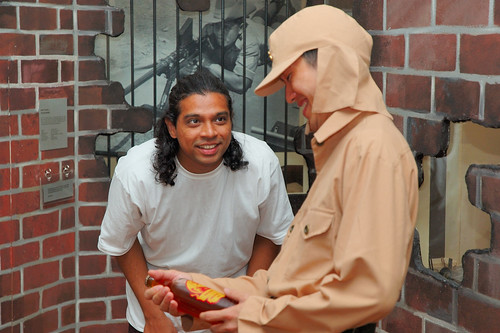
It was a play. A play about the wartime period. But it was not just a play that you watch while sitting on a small red plastic chair. It was one that managed to momentarily transport each and every one of the participants back to the war torn Singapore of 1942.

The sounds, the people, the fear and the war. All was brought before the eyes of the participants.

But you'd have to be there to feel what I've feebly tried to describe. But I do have to say that it was a very fun trail, for all of the participants and the guides too. But for this exciting event, we only held it for 2 days, on the 3rd and 4th of September 2005, and only for 2 sessions per day, once at 9am and the other at 11am.
The reason for the short duration and lowered number of session was that the guides were already low on energy after the July Heritage Fest and the small pool of guides further limits this activity. So, in hope of improving the situation, we appeal to anyone who is interested in this event to sign up as a guide! Yes! Come join us and help to extend this exciting event to others!

If you are interested, please send an email to Kiah Shen at tikigu@yahoo.com.sg ! Our next event will be around the 12th of Feb 2006, but if we have enough new guides, we may consider making this Trail a quarterly event! Do join!
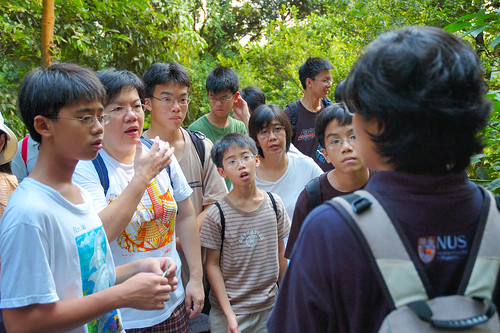
This time round, however, the 60th Anniversary Memorial Edition proved to be a multisensory, engaging and exciting journey that even surprised the guides themselves! The nature guiding portion remained the same (as it was already exciting enough, with all the green crested lizards, happy white crested laughing thrushes and oriental whip snakes basking in the morning sun) After the initial nature walk through the Kent Ridge Park, the participants were brought to the Reflections at Bukit Chandu. This was the part that was new, exciting and absolutely unexpected.

It was a play. A play about the wartime period. But it was not just a play that you watch while sitting on a small red plastic chair. It was one that managed to momentarily transport each and every one of the participants back to the war torn Singapore of 1942.

The sounds, the people, the fear and the war. All was brought before the eyes of the participants.
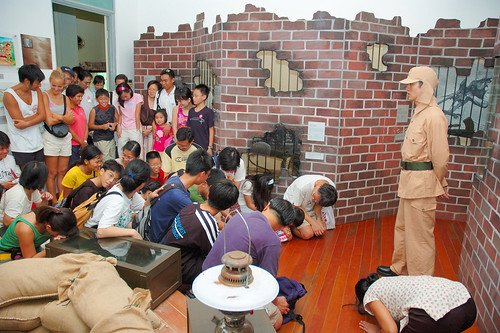
But you'd have to be there to feel what I've feebly tried to describe. But I do have to say that it was a very fun trail, for all of the participants and the guides too. But for this exciting event, we only held it for 2 days, on the 3rd and 4th of September 2005, and only for 2 sessions per day, once at 9am and the other at 11am.
The reason for the short duration and lowered number of session was that the guides were already low on energy after the July Heritage Fest and the small pool of guides further limits this activity. So, in hope of improving the situation, we appeal to anyone who is interested in this event to sign up as a guide! Yes! Come join us and help to extend this exciting event to others!
If you are interested, please send an email to Kiah Shen at tikigu@yahoo.com.sg ! Our next event will be around the 12th of Feb 2006, but if we have enough new guides, we may consider making this Trail a quarterly event! Do join!
Sunday, 4 September 2005
Pasir Panjang Heritage Day 2 and War Vets Forum
The Pasir Panjang Heritage guides spent Sunday morning illustrating the Battle of Pasir Panjang and the flora (more than the fauna) of the park. It was Day 2 of our special September sessions in commemoration of Memorial Month.
September is Memorial Month and with STB promoting the events especially the conference and commemoration ceremony, we have received more visitors from overseas interested in the war this time.
I put up some half-hearted photos here. I know our NAS partner Stella took more with a heavy-duty SLR today, so am looking forward to those.

Our secret weapon for this walk is the ice cream man - it's no accident he's there, Project Managers Kiah Shen and Wendy call him!
 Later Anand, Kenneth & I scampered off for the war vets forum at Singapore History Museum (now at Riverwalk). This photo was taken by Stephanie Hester, a PhD student from Univ. Adelaide in town for the Memorial Month. We guided her at Pasir Panjang earlier.
At the forum I finally met Kark Hack and Kevin Blackburn with whom I had first corresponded with in 2002 for a loan of their map on the Changi (WWII) historic area 1942-2002. It was then a pre-print book and the expensive hardback came out in 2004, I believe. The paperback was launched today and I grabbed a copy from the Select Books counter for $37.50 once I walked in.

Romen Bose was there so we ribbed him about throwing a spanner in the works with that mornings news (from his forthcoming book) about the actual date of the Japanese surrender!
It was an enjoyable forum and we heard a variety of experiences and I have copious notes; unfortunately I had to leave near 6pm before the third session began.
First posted on Otterman speaks, 04 Sep 2005.
September is Memorial Month and with STB promoting the events especially the conference and commemoration ceremony, we have received more visitors from overseas interested in the war this time.
I put up some half-hearted photos here. I know our NAS partner Stella took more with a heavy-duty SLR today, so am looking forward to those.
Our secret weapon for this walk is the ice cream man - it's no accident he's there, Project Managers Kiah Shen and Wendy call him!
Later Anand, Kenneth & I scampered off for the war vets forum at Singapore History Museum (now at Riverwalk). This photo was taken by Stephanie Hester, a PhD student from Univ. Adelaide in town for the Memorial Month. We guided her at Pasir Panjang earlier.At the forum I finally met Kark Hack and Kevin Blackburn with whom I had first corresponded with in 2002 for a loan of their map on the Changi (WWII) historic area 1942-2002. It was then a pre-print book and the expensive hardback came out in 2004, I believe. The paperback was launched today and I grabbed a copy from the Select Books counter for $37.50 once I walked in.
Romen Bose was there so we ribbed him about throwing a spanner in the works with that mornings news (from his forthcoming book) about the actual date of the Japanese surrender!
It was an enjoyable forum and we heard a variety of experiences and I have copious notes; unfortunately I had to leave near 6pm before the third session began.
First posted on Otterman speaks, 04 Sep 2005.
Saturday, 3 September 2005
Pasir Panjang Heritage Walk this morning
While the International Coastal Cleanup Singapore: Kranji Mangroves team were on their way to Sungei Buloh this morning, some of the Raffles Museum's Pasir Panjang Heritage guides were heading down south to join Stella Wee of National Archives in welcoming visitors and finding lost souls at Harbour Front.
I had an old timer and long-time resident in my group who added his own stories to the guiding - this is always fun for the guide as it makes the session more conversational and is a rare opportunity to learn while guiding.

This time, the walk ended at Reflections at Bukit Chandu with a wonderful surprise - an enactment by a drama company. They did a good job, I thought, from the little I saw, although the heritage guides found themselves skipping content to make it to Bukit Chandu in time for this session.
I skipped the second session to donate blood but the others told me they went through the enactment and our biggest guide obediently knelt when yelled at by a 'Japanese officer' - the actor savoured the moment when the rest followed suit. We later suggested the gravity of the situation might have had him confused with his Catholic mass, but we'd better continue that investigation tomorrow. Wish I was there to see it, but I really feel that was probably just sympathetic acting.

Although I will miss the Kranji Commemoration Ceremony, the Pasir Panjang Heritage guides and Adrian Loo (Changi Heritage) will be at the ceremony.
First posted to Otterman speaks, 03 Sep 2005.
I had an old timer and long-time resident in my group who added his own stories to the guiding - this is always fun for the guide as it makes the session more conversational and is a rare opportunity to learn while guiding.
This time, the walk ended at Reflections at Bukit Chandu with a wonderful surprise - an enactment by a drama company. They did a good job, I thought, from the little I saw, although the heritage guides found themselves skipping content to make it to Bukit Chandu in time for this session.
I skipped the second session to donate blood but the others told me they went through the enactment and our biggest guide obediently knelt when yelled at by a 'Japanese officer' - the actor savoured the moment when the rest followed suit. We later suggested the gravity of the situation might have had him confused with his Catholic mass, but we'd better continue that investigation tomorrow. Wish I was there to see it, but I really feel that was probably just sympathetic acting.
Although I will miss the Kranji Commemoration Ceremony, the Pasir Panjang Heritage guides and Adrian Loo (Changi Heritage) will be at the ceremony.
First posted to Otterman speaks, 03 Sep 2005.
Subscribe to:
Posts (Atom)
